

The game received its own logo and became friendlier to search engines: the specialised tags now state that «Ізоманія» and Isomania are synonyms.
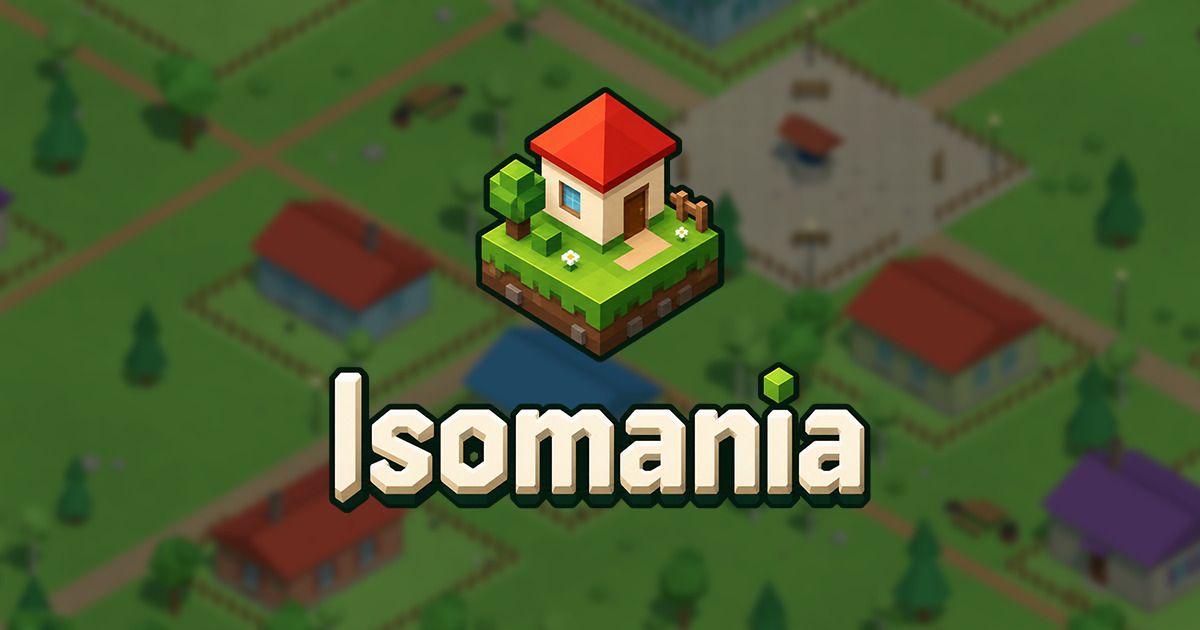
The mark and the name became one image
The mark (favicon) and the name used to exist separately: a drawn cottage in the icon and the word Isomania set in whatever font the machine happened to have. Now it is a single image — a cottage on a grass tile with a tree and a fence, beside letterforms with their own depth and a green cube over the “i”. The logo is used everywhere the name works as a mark: on the loading screen, on the sign-in card, in the settings, at the head of every email and here in the blog.


The logo in emails was invisible
The logo in emails was most likely not seen by the majority of recipients: it was an SVG, which Gmail strips out entirely and Outlook has never supported. It is a PNG now, and at an address without a version number: an email sent today will still be sitting in an inbox next year, when an address carrying the current build number no longer resolves.
The tab icon was checked at real sizes. At 16 pixels the cottage turns into a red roof on a green background, while at 32 it reads as a house with a tree, so the 16-pixel size is simply not declared.
The source files weighed 790, 463 and 289 kilobytes, which the loading screen cannot afford, since its job is to appear before everything else. After reducing the number of colours to the palette the artwork already uses, the files weigh 36, 29 and 2 kilobytes, with a deviation the eye cannot find.
The page learned to speak about itself
To a search engine this game was a blank space: the page consists of a canvas and a connection, and every word on it appears only after signing in. The page now has its own title and description, structured data, and a separate file describing the game in plain sentences for language models.
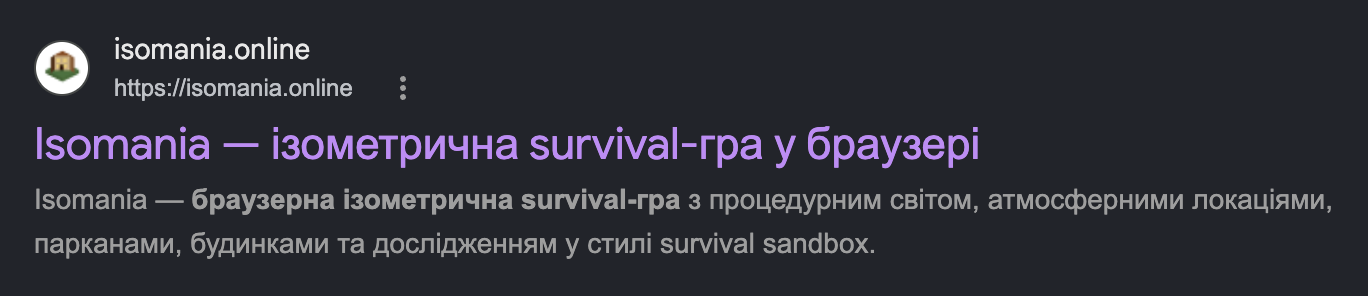
The main thing in all of this is the name itself. «Ізоманія» is a transliteration rather than a translation: no dictionary contains that pair, and no amount of crawling the page would derive it. So the equivalence is stated explicitly and in three ways at once: in the text of the title and description, in the structured data of both entities, and as a separate sentence in the file for language models.
A visitor counter without weakening the protection
Visitor analytics appeared on the site, and almost all of the work went into what the counter did not get. The page’s security rules were not weakened: the script was moved into a separate file instead of the inline fragment those rules forbid.
Ad personalisation is switched off, and not by a flag but by the absence of permission for the corresponding domain, so a lost configuration will fail in the direction of collecting nothing. The thread that processes the camera image has no access to analytics at all.
Analytics runs on the production server only, so local reloads during development do not end up in the player statistics.